
Cheesy Road Game: Strategies & Analysis
Three tested approaches with real math. No "guaranteed win" nonsense — just smarter ways to manage variance and extend your sessions. By Cheesy Road Editorial Team.
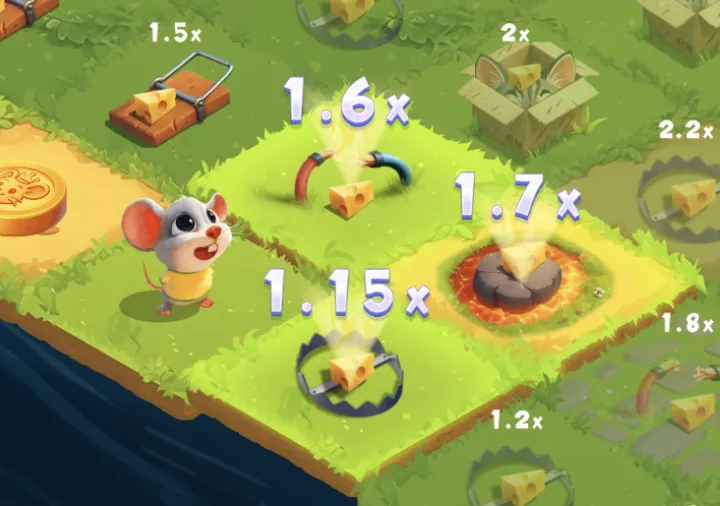
The strongest use of a strategy guide is preparation, not prediction. Read the notes before a session, choose one approach to test, and avoid mixing several systems just because the last round went badly. Most avoidable mistakes happen when players change targets too quickly, raise stakes out of frustration, or treat a short streak as proof that the game has become predictable.
Keep the plan small enough to follow when the pace gets quick. Demo rounds are useful for checking timing and comfort level, while real-money rounds should stay tied to a fixed budget, fixed stake range and clear exit point. That makes each decision easier to review later.
When you treat strategy as discipline rather than prediction, the experience becomes easier to manage. You still accept risk, but you make fewer rushed decisions, protect the bankroll better, and keep more control over the session. That is the kind of strategy that holds up after the first few rounds.
June 2026 Strategy Notes
Before you play Cheesy Road, use this page to slow the session down. Look first at lane selection, chicken-crossing volatility and bankroll discipline. These are the parts of the game that usually make a balance move faster, so choose your stake and stop point before the first round or spin. A small plan is easier to follow than a complicated system, especially after a quick win or a frustrating loss.
A useful warm-up is simple: test one crossing plan in demo before raising the road level or stake. Keep the same stake during the test, then write down the starting balance, ending balance and whether you stopped where you planned. That short note tells you more than a lucky result because it shows whether the plan was realistic while the game was moving.
If you play with a bonus, read the wagering rules, max bet, expiry date and withdrawal limits before changing anything. The best strategy is usually the one that keeps decisions calm: clear limits, fewer rushed clicks and no attempt to win back a result that has already happened.
No Strategy Beats the House Edge
The mathematical house edge in Cheesy Road means the casino profits over time — every time, without exception. The strategies below help you manage variance and extend your play sessions. They do not guarantee wins. They do not eliminate risk. If someone tells you they have a "foolproof Cheesy Road strategy," they're lying or selling something.
Never gamble money you can't afford to lose. If gambling stops being entertainment, get help here.
Understanding the Math Behind Cheesy Road
RTP and House Edge
RTP (Return to Player) represents the percentage of wagered money returned to players over a large sample. If Cheesy Road's RTP is approximately 95%, that means for every $1,000 wagered across thousands of rounds, players receive about $950 back. The casino keeps $50 — that's the house edge (5%).
Here's what that looks like in practice with a $100 session bankroll:
| Scenario | RTP 94% | RTP 96% | RTP 97% |
|---|---|---|---|
| $100 wagered | $94 returned | $96 returned | $97 returned |
| $500 wagered | $470 returned | $480 returned | $485 returned |
| $1,000 wagered | $940 returned | $960 returned | $970 returned |
| House keeps per $100 | $6 | $4 | $3 |
These are long-term statistical averages. Individual sessions can vary dramatically — you might double your money or lose everything in 20 minutes. The RTP only applies over thousands of rounds.
Variance vs Expected Value
Expected value (EV) tells you the mathematical average outcome. In Cheesy Road, your EV per round is always slightly negative because of the house edge. But variance is what makes individual sessions unpredictable. High-variance play (hard paths, big multiplier targets) means your results swing wildly — huge wins mixed with frequent losses. Low-variance play (easy paths, early cash-outs) keeps results closer to the EV average.
Neither high-variance nor low-variance play changes the house edge. The choice between them changes how your session feels. Low variance = longer sessions with small fluctuations. High variance = shorter sessions with dramatic swings. Pick whichever matches your entertainment preference and budget.
Why "Hot Streaks" Don't Exist
Each round in Cheesy Road is independent. The game's RNG generates trap placement fresh every time. Winning 5 rounds in a row doesn't mean the 6th is more likely to lose. Losing 10 rounds straight doesn't make the 11th "overdue" for a win. This is the gambler's fallacy, and it's the most expensive misconception in gambling. Your past results have zero influence on future outcomes.
Strategy 1: Conservative (Low Risk)
How It Works
Use only easy and medium paths (green arrows). Avoid the blue lightning arrow entirely. Take 2-3 steps per round and cash out as soon as your accumulated multiplier hits 1.5x or 2x. Don't push for bigger numbers. The goal is survival — staying in the game for as many rounds as possible while collecting small, consistent wins.
Round-by-Round Example
| Round | Bet | Steps | Path | Multiplier | Result | Balance |
|---|---|---|---|---|---|---|
| 1 | $1 | 2 | Easy, Easy | 1.15x | +$0.15 | $100.15 |
| 2 | $1 | 3 | Easy, Med, Easy | 1.65x | +$0.65 | $100.80 |
| 3 | $1 | 1 | Easy | Trap | -$1.00 | $99.80 |
| 4 | $1 | 2 | Easy, Easy | 1.25x | +$0.25 | $100.05 |
| 5 | $1 | 3 | Med, Easy, Easy | 1.85x | +$0.85 | $100.90 |
In this example, 4 wins out of 5 rounds (80% win rate with easy paths). Total wagered: $5. Total returned: $5.90. Profit: $0.90. That's a 118% RTP for this micro-sample — but remember, this won't hold over hundreds of rounds. The house edge catches up.
When to Use This
- You're learning the game and don't want to burn money fast
- You want entertainment value — 60+ minutes of play from a modest bankroll
- You'd rather win $0.50 ten times than risk losing $10 chasing a 10x multiplier
Honest Downside
It's boring. Cashing out at 1.5x every round doesn't give you the adrenaline rush that Cheesy Road is designed to deliver. And if the house edge is 5%, your small wins slowly erode over time. After 200 rounds at $1 bets, you'll likely be down $5-15 from your starting balance. It's the safest way to play, but it's still a losing proposition mathematically.
Strategy 2: Balanced (Medium Risk)
How It Works
Start each round with 1-2 easy path steps to build a small base multiplier. Then take one medium or hard step to push toward 3x-5x territory. Cash out immediately after the risky step — don't push for a second one. The idea is that your safe opening steps build a buffer, and one calculated risk per round gives you a shot at meaningful returns.
I used this approach for my main testing sessions. Win rate drops to around 50-60%, but the average win amount is higher than the conservative approach. A single 4x-5x round covers 3-4 losses.
The Decision Framework
| Current Multiplier | Action | Reasoning |
|---|---|---|
| 1.0x - 1.3x | Take another step (easy/medium) | Low accumulated value, acceptable risk to continue |
| 1.3x - 2.0x | Take one more step OR cash out | Decent base — one more step if the board looks favorable |
| 2.0x - 3.0x | Cash out unless Ghost Mode active | Solid return, diminishing marginal value of one more step |
| 3.0x+ | Cash out immediately | Anything above 3x is a good round. Don't get greedy. |
| Ghost Mode active | Take one hard step, then cash out | Free insurance — use it on the highest-risk arrow |
Ghost Mode Advantage
Ghost Mode is the balanced strategy's best friend. When the mouse turns blue, you effectively get a free pass through one trap. The optimal play: take the blue lightning (hard) arrow during Ghost Mode, survive the trap if there is one, then immediately cash out. This gives you a risk-free shot at a high multiplier tile. Without Ghost Mode, the balanced strategy avoids the hard path entirely.
Honest Downside
The balanced approach requires discipline and decision-making on every round. Some players find the constant evaluation mentally tiring. And the 50-60% win rate means you'll have stretches of 5-6 losses in a row — which feels worse than the conservative approach even if the math works out similarly over time.
Strategy 3: Aggressive (High Risk)
How It Works
Use the blue lightning arrow from the start. Aim for 4+ steps deep into the board where multipliers reach 5x, 10x, or even higher. Accept that you'll lose most rounds — the win rate drops to 25-35%. But when you do survive, a single 10x-20x round recovers many lost bets.
This is essentially a "home run" approach. You're swinging for big hits and accepting that most swings will miss. The math doesn't favor it any more than conservative play — the house edge is identical. But the session experience is completely different: short, intense, and emotionally volatile.
Session Example
| Rounds 1-5 | Result | Running P/L |
|---|---|---|
| $1 bet, hard path, step 1 | Trap. -$1 | -$1 |
| $1 bet, hard path, step 1 | Trap. -$1 | -$2 |
| $1 bet, hard, hard, medium | Cash out 4.5x. +$3.50 | +$1.50 |
| $1 bet, hard path, step 2 | Trap. -$1 | +$0.50 |
| $1 bet, hard path, step 1 | Trap. -$1 | -$0.50 |
Notice: one successful 4.5x round almost covered four losses. That's the appeal. But it requires emotional control to keep betting $1 after three losses in a row. And there's no guarantee that the fourth round will be the winner.
When to Use This
- You have a strict, pre-set loss limit you will absolutely honor
- You prefer short, intense sessions over long grinding
- You've mastered the mechanics in demo and understand trap frequencies
- You treat the entire session bankroll as entertainment expense — money you've already mentally "spent"
Honest Downside
This strategy bleeds money fast. A bad streak of 10-15 losses is entirely possible and costs $10-15 at $1 bets. The emotional toll of repeated losses pushes players to increase bet sizes (chasing), which accelerates the drain. I've seen my own bankroll vanish in under 10 minutes using this approach. Only use it if you can genuinely walk away when your loss limit hits.
Bankroll Management (The Real Strategy)
Bankroll management determines session longevity more than path selection or cash-out timing. Your direction choices affect variance, but how you size your bets determines whether you last 10 rounds or 100. Bad bankroll management ruins even the best approach.
The 1-2% Rule
Never bet more than 1-2% of your session bankroll on a single round. With $100, your max bet is $1-2. With $50, keep it at $0.50-1.00. This ensures you have at least 50-100 rounds of play even during losing streaks. Betting 5-10% per round means one bad streak of 10 rounds wipes half your bankroll — and 10-round losing streaks happen more often than you think.
Session Loss Limit
Before you start, decide the maximum you're willing to lose. I use 20% of my session bankroll. If I start with $100, I stop at $80. No exceptions. No "just one more round." Set it. Honor it. Leave.
Win Target
Set a target profit too. If I'm up 30% ($130 from $100), I cash out and walk away. Giving back winnings because you wanted "just a bit more" is the second most common mistake after chasing losses.
Time Limits
Set a timer. 30 minutes or 60 minutes max per session. After extended play, decision quality degrades — you get tired, impulsive, and start making emotional bets. Casinos design games to keep you playing. A timer fights that. I use the alarm on my phone, not a mental note.
| Bankroll | Max Bet (2%) | Loss Limit (20%) | Win Target (30%) | Min Rounds |
|---|---|---|---|---|
| $25 | $0.50 | Stop at $20 | Cash out at $32.50 | 50 |
| $50 | $1.00 | Stop at $40 | Cash out at $65 | 50 |
| $100 | $2.00 | Stop at $80 | Cash out at $130 | 50 |
| $200 | $4.00 | Stop at $160 | Cash out at $260 | 50 |
What Doesn't Work (Myth Busting)
Myth: "The game is due for a win"
Reality: Each round is independently generated by the RNG. Ten losses in a row don't make the 11th round more likely to win. This is the gambler's fallacy — one of the most expensive misconceptions in gambling. The game has no memory of your previous rounds.
Myth: "Martingale guarantees recovery"
Reality: Doubling your bet after each loss (Martingale) requires exponential bankroll growth. After 7 consecutive losses at $1 base, you'd need to bet $128. After 10 losses: $1,024. Casino bet limits cap you long before that, and the expected value of each bet remains negative regardless of size. Martingale doesn't change the math — it just makes your eventual loss bigger.
Myth: "Higher bets = better RTP"
Reality: RTP is fixed by the game's algorithm, not by your bet size. A $0.10 bet and a $100 bet have the exact same probability of hitting traps and the same multiplier distribution. The only thing that changes with bet size is how much you win or lose per round.
Myth: "There's a pattern in trap placement"
Reality: SmartSoft Gaming uses a certified RNG for trap placement. The board is randomly generated for each round. There's no pattern to memorize, no "safe zones" that repeat, and no predictable sequences. Anyone selling a "trap prediction system" is scamming you.
Myth: "Playing at specific times improves odds"
Reality: The RNG operates identically regardless of time of day, day of week, or server load. The game doesn't "loosen up" at 3 AM or "tighten" during peak hours. This myth likely comes from selective memory — players remember the 3 AM session where they won and forget the 50 other 3 AM sessions where they lost.
Content Update History
- — Retested all three strategies over 200+ rounds, updated session examples and bankroll table
- — Initial publication with mathematical analysis and three strategy approaches
Optimistic Strategy Outlook
Cheesy Road is most rewarding as a strategy exercise when the player treats each path as a different entertainment profile, not as a hidden shortcut to profit. The easy route, medium route, hard route, Ghost Mode, and early cash-out ranges give enough structure to build a thoughtful session before the mouse starts moving. That is the encouraging part: a player can decide whether the goal is longer play, a balanced shot at 2x-3x, or a small high-risk allocation, then keep every bet inside the 1-2% bankroll rule. The game still has a house edge, but the decision tree is visible enough to make discipline feel concrete.
The optimistic plan is to turn Cheesy Road into a repeatable routine. Start in demo mode, write down the route and cash-out target, and treat Ghost Mode as a useful bonus rather than permission to abandon limits. When the session is reviewed later, the most valuable question is simple: did the plan survive the pressure? If yes, the player has gained control, clarity, and a better entertainment experience.
Frequently Asked Questions
Does the Martingale strategy work in Cheesy Road?
No. Martingale (doubling your bet after each loss) fails in Cheesy Road for the same reason it fails everywhere: table limits cap your maximum bet, and a losing streak of 7-8 rounds requires 128x-256x your base bet to recover. A $1 base bet needs $256 after 8 losses. The house edge doesn't change regardless of bet size. Martingale just accelerates your losses during a bad streak while creating the illusion of safety during good ones.
What is the safest path in Cheesy Road?
The easy path (green arrows, excluding the blue lightning) offers the lowest trap probability per step. Multipliers are small (1.05x-1.3x per tile) but survival rates are noticeably higher than medium or hard. Combining easy paths with early cash-outs at 1.5x-2x is the lowest-variance approach in Cheesy Road. But "safest" doesn't mean "profitable" — the house edge still applies.
Should I always cash out at the same multiplier?
Consistency helps with discipline, but rigid targets miss opportunities. A better approach: set a minimum cash-out target (like 1.5x) but allow flexibility. If Ghost Mode activates, take one more risky step before cashing out. If you're on a 4-step streak with no traps, consider pushing to 3x. The key rule: never skip a cash-out when your instinct says stop. Greed costs more than missed opportunities in this game.
How much should I bet per round?
Never more than 1-2% of your session bankroll. With $100, bet $1-2 per round. This gives you 50-100 rounds minimum, even during a losing streak. Betting 10% per round means you could burn through your bankroll in 10 bad rounds — and that happens more regularly than players expect. Consistent small bets protect your bankroll and give you more data points to evaluate your strategy.
Can I predict which tiles have traps?
No. Trap placement is determined by the server's RNG before each round starts. The multiplier values on tiles are visible, but trap locations are hidden until the mouse lands on them. Higher-multiplier tiles generally correlate with higher trap probability, but there's no way to know which specific tile hides a trap. Anyone claiming to predict traps is either guessing or selling something that doesn't work.
Next Steps
- Practice these strategies in free demo mode — no registration, no risk
- Review the complete rules and interface guide — make sure you understand every mechanic first
- Check available casino bonuses — extra funds to test strategies with